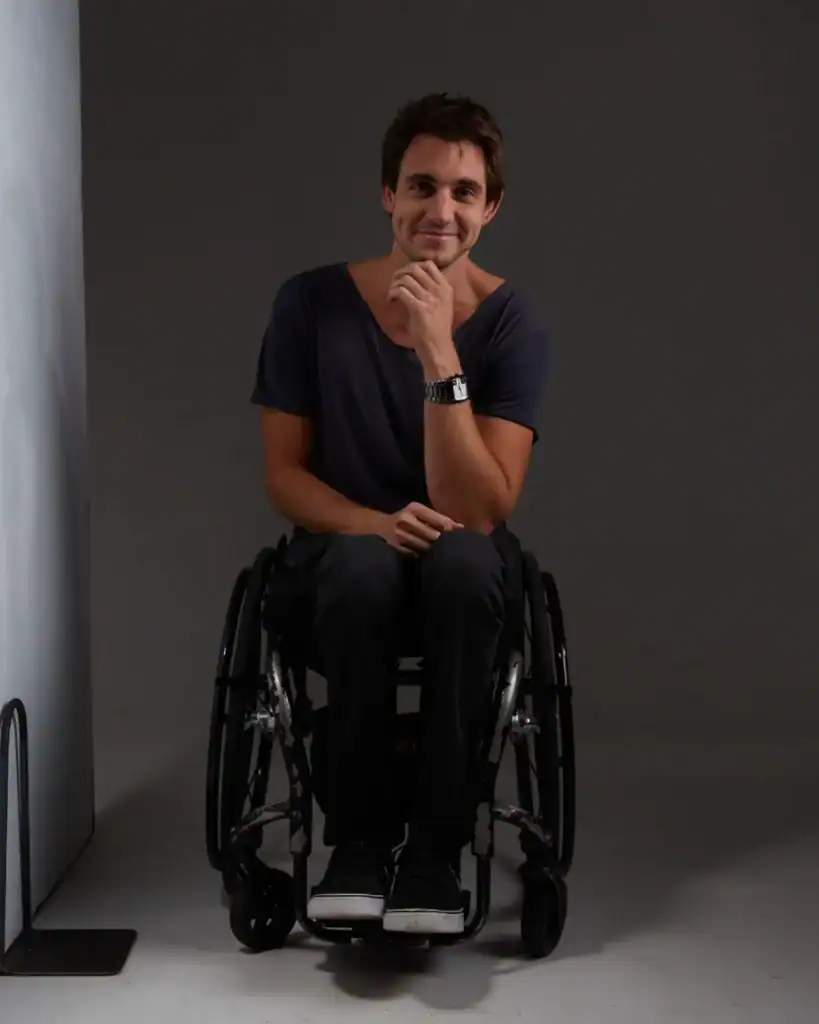
Hi, I’m Dean.
I’m from Wollongong on the south coast of New South Wales, Australia. Travel has always been a big part of what makes me happy. Long before I used a wheelchair, I was the kind of person who wanted to be outside doing something — surfing, skating, snowboarding, travelling or just finding somewhere new.
I have always found a way to travel
I got my first job when I was 13 and the motivation was pretty simple: I wanted money for surf trips up and down the coast and trips to the snow. Travel wasn’t something I suddenly discovered later in life. I have pretty much always worked out how to make it happen.
After finishing my undergraduate degree, I bought a one-way ticket to Europe and set off to live the backpacker life that a lot of young Australians dream about. I was 20 years old and started the trip with a snowboard season in the French Alps.
Before the accident — a quick glimpse of who I already was
The trip that changed everything
About three months into that trip, I had an accident in a terrain park and everything changed. I broke my back in four places and sustained an incomplete spinal cord injury at T12. I also suffered a severe traumatic brain injury — actually my second, after an earlier skateboarding accident.
I spent almost a month in hospital in France before I was stable enough to be flown home to Australia. From there I moved into the spinal ward at Prince of Wales Hospital for the next few months and started figuring out what life was going to look like from then on.
I cannot stand or walk and I use a manual wheelchair full-time. Looking on the bright side, the level of my injury means I have full control of my upper body from around my ribs up. That has a pretty significant influence on the way I travel today and on what I am physically able — and sometimes stubborn enough — to attempt.
Recovery became my full-time job
When I first came home, physiotherapy was basically my entire life. I was determined to leave no stone unturned. If there was something I could do that might help me retain or improve my physical capacity, I wanted to do it. If you read enough of the stories on this site, you will probably realise that stubborn streak is still a fairly significant part of my personality.
Towards the end of that year I realised I needed something in my life that was not rehabilitation. I got a job at the university and, two months later, started a Master of Business Administration. For the next few years I threw myself into work, study and physiotherapy.
The thing I stopped doing
Looking back, I was also avoiding something that had previously been a huge part of who I was: travelling.
Before my accident I could book a cheap hostel, get on a plane and mostly work everything else out when I arrived. Suddenly I had to think about whether I could get into the accommodation, whether the bathroom would work, how I would get from the airport, whether public transport was accessible, what I could actually do when I reached an attraction, and what would happen if the information I had been given turned out to be wrong.
For a while, it seemed easier not to deal with it.
Instagram eventually annoyed me into doing something
About five years after my accident, I was scrolling through Instagram and watching what everyone else seemed to be doing. Friends were travelling through North and South America. Others were on beaches in Portugal, at Tomorrowland in Belgium or exploring Africa. It felt like everybody was out there doing something while all I was doing was working and saving money.
Eventually I thought: What exactly am I saving it for? There’s no benefit being the richest guy in the graveyard.
I gave myself a challenge. Before the end of the year I had to take a solo international trip. I chose Hawaii, partly because it felt symbolic: I wanted to go somewhere a long way from anyone I already knew and prove to myself that I could make it work.
I did not want the sanitised version of Hawaii where I checked into a resort, sat beside the pool and drank cocktails for a week. I wanted hostels, public transport, random people and days spent exploring. If there was a mountain, cave, beach, trail or viewpoint worth getting to, I wanted to know whether I could get there.
Almost immediately, something went wrong
A colleague’s wife was a travel agent and had helped me organise the trip. When I arrived in Kauai at Castle Mokihana, it turned out they did not actually have a wheelchair-accessible room that worked for me. As usual, the bathroom was the limiting factor.
The people working there were incredibly kind. They rang another hotel nearby, found me a room and actually drove me there themselves.
It was not how I wanted the trip to start, but it taught me something important very quickly: things are going to go wrong. They might be inconvenient, frustrating or sometimes really unpleasant, but it would take something pretty extreme for a problem to become completely insurmountable. I would find another hotel, another route, somebody to ask, or another way of making it work.
That realisation probably did more for my confidence than if everything had gone perfectly.
The trip that got me travelling again
Why I still like hostels
Cost is part of it, but it has never been the whole reason I like hostels. When you are travelling alone and staying in a hotel, it is very easy to spend the whole trip by yourself. In a hostel, you are surrounded by people who have often chosen the same style of travel. You meet somebody at breakfast, start talking about what you are doing that afternoon and a few hours later you are exploring somewhere together.
When I travel alone, I will still usually look at hostels for exactly that reason. Travelling with Bre is a little different. I already have somebody to experience the trip with, so the social side matters less and location, convenience, accessibility and price become the bigger priorities.
I am independent, but I definitely do not do all of this alone
I am incredibly lucky to have the family and friends that I do. They have given me an enormous amount of love and support since my accident, and some of the experiences on this site simply would not have happened without them.
My closest mates have also developed a fairly practical approach to inaccessible accommodation. On one trip to Spain, the apartment we booked had an elevator — which sounded promising — except the apartment itself was effectively halfway between floors. We could take the lift to level three and carry me down a flight of stairs, or get out at level two and carry me up.
Even when we got home at 7am, the boys would play paper, scissors, rock to decide who had to carry me. This was also where we established that my mate Brad may be the world’s worst paper, scissors, rock player. Somehow, time after time, he lost.
The same group later helped me make my way up to the Sant Jeroni lookout at Montserrat. By the time we reached it, people were looking at us as though we had appeared from nowhere.
The people who make the stories better
Bre knows what happens when I get an idea
Bre has learned that once I decide I want to try something, talking me out of it can be difficult. I have heard plenty of versions of “are you sure it’s worth it?”, “you’ll regret it if it goes wrong” and the wonderfully non-committal “you’re a big boy, it’s your decision…”
Sometimes she is right. I have fallen out of my chair, scraped myself up and lost a bit of skin more than once. Usually, once the drama is over, we end up laughing about it.
Bryce Canyon is a good example. On the way down into the canyon I had a fall and Bre and some other people helped me get back up. We eventually reached a section that was simply too steep and where the risk of carrying too much speed was too high. If it went wrong there, it was a long way down, and that was finally enough to make me turn around.
The funny part is that all I had been thinking about on the way down was the danger of having a big accident. At no point had I seriously considered how much effort it was going to take to push myself all the way back to the top. Bre’s help on the climb back out was definitely needed.
What my version of “manageable” means
This context matters because accessibility is personal. I use a manual wheelchair, I have good upper-body strength, I am a confident wheelchair user and I am willing to put in physical effort to reach somewhere that I think will be worth it.
That means my version of manageable may be completely different from somebody else’s. A power-wheelchair user, somebody with less upper-body strength, somebody with limited balance, or somebody who simply does not want to spend a holiday wrestling with rocks and hills may make a different call.
When I say I could do something…
I am describing my experience, not certifying that it will work for every wheelchair user. If I needed a push, a lift, a front wheel, help from Bre or three mates willing to carry me up some stairs, I want to tell you that too.
Travel is not my full-time job
I work full time as an investment analyst. Like most people, I do not have unlimited annual leave, free time or money, so I cannot be travelling constantly even though I would happily spend a lot more of my life doing it.
That also means the updates on this site will probably come in bursts rather than on a perfect content calendar. I would rather post something useful from every trip where I have a story or practical information worth sharing than publish for the sake of keeping up a schedule.
On top of my full-time job, I co-founded Headlands Distilling Co as a side hustle in 2015. I do not want this site to become a distillery blog, but Headlands has created some pretty interesting reasons to travel. That has included private tastings at sherry bodegas in Jerez and visits to barrel cooperages around Montilla in Spain, trade shows in Shanghai, and travelling to San Francisco for the San Francisco World Spirits Competition awards gala for our Illawarra Plum Cask Whisky.
Sometimes a trip starts because of work or whisky and then turns into another excuse to explore somewhere new. Those parts of the story will make it onto the site when they are relevant.
A few other parts of my life
The idea that would not go away
Hawaii was where I first had the idea for this website. I bought the domain and started writing about my experience, but I never really pulled the trigger. Every trip after that brought the idea back.
I often end up in places where people start taking photos or videos because they cannot believe I have managed to get there. They tell me about a nephew, friend or neighbour who uses a wheelchair and say they wish that person realised how much more might be possible. People sometimes tell me that what I am doing is inspiring. I never quite know how to respond because, from my perspective, I am just being me.
I am not travelling to prove a point. I travel because I like travelling. I like national parks, mountains, road trips, food, hostels, bars, meeting random people and occasionally making questionable decisions because there might be something interesting at the end of them.
Why now?
Planning my first trip to Japan in 2026 finally pushed me to stop talking about this website and actually build it. Finding accommodation that worked for me was not straightforward. I kept running into the same problems I had encountered years earlier when planning Hawaii: vague accessibility descriptions, hotel photos that did not show the things I actually needed to see, and a huge amount of research just to answer basic questions.
I am also not somebody who automatically wants a luxury accessible hotel. I am generally happy with basic accommodation if it is clean, workable and in the right place. I would rather save money on the room and spend it eating, drinking, travelling and doing things once I get there. My approach is usually location first, then the best balance between accessibility, convenience and price.
Japan reminded me that there are probably plenty of other wheelchair users doing exactly the same research. So this time I am actually finishing the website.
There is a bigger reason for sharing it too
I am a Community Ambassador for SpinalCure Australia. Raising awareness of spinal cord injury is important to me, and so is supporting the work that goes into research and fundraising.
I do not want every travel story to become a speech about spinal cord injury, but the two things naturally overlap. If sharing what my life actually looks like helps somebody understand spinal cord injury a little better, challenges an assumption about what is possible, or helps generate more awareness and support for the cause, that is a meaningful outcome for me.
What I hope comes from it
I would love this site to inspire and motivate people, help somebody take a trip they were not sure they could take, and eventually build a community where people share useful first-hand information with each other.
At the very least, I will have a permanent record of the places I have been, the ridiculous situations I have found myself in, the people I have met and the photos and videos that went with them. That is something I will be pretty happy to have for my friends and family forever.